Connors RSI-2
Verified — this backtest ran on Tessen's own engine and data. The inputs can't be faked.
On data it never saw, the agent averaged -3.75bp per trade after costs (win rate 47.8% — irrelevant when losers outweigh winners). Historically, 42.3% of similar strategies (same timeframe/entry indicator) also fail this (N=52).
Try: This is an entry-signal problem, not a tuning problem. Change the core idea: different condition, different timeframe, or add a regime filter (e.g. only trade high-volatility periods) — don't just widen stops.
It loses on AVAX/USDT:USDT, BNB/USDT:USDT, DOGE/USDT:USDT, ETH/USDT:USDT, XRP/USDT:USDT — under 60% of its universe is positive, which usually means the backtest found luck, not a mechanism. Historically, 42.3% of similar strategies (same timeframe/entry indicator) also fail this (N=52).
Try: Either the thesis only applies to certain assets (then say so — trim the universe to where the mechanism makes sense), or the signal is noise. Ask: WHY would this work on some symbols and not others?
Simulated at responsible sizing, the worst drawdown hits 89% — deep enough that most people abandon the strategy exactly at the bottom. Historically, 23.1% of similar strategies (same timeframe/entry indicator) also fail this (N=52).
Try: Cut risk per trade, tighten the catastrophe stop, or reduce concurrent positions. An edge you can't hold through its drawdown is an edge you don't have.
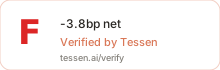
<a href="https://tessen.ai/verify/beecba44-685b-443d-8d99-4dc33f4e0322"><img src="https://api.tessen.ai/v1/badge/beecba44-685b-443d-8d99-4dc33f4e0322.svg" alt="Tessen Grade" /></a>
A Tessen Grade is a historical, out-of-sample statistical measurement — not investment advice, a prediction, or a guarantee of future results. Most strategies fail; a passing grade can stop working as markets change. Trading involves substantial risk of loss. Full risk disclosure